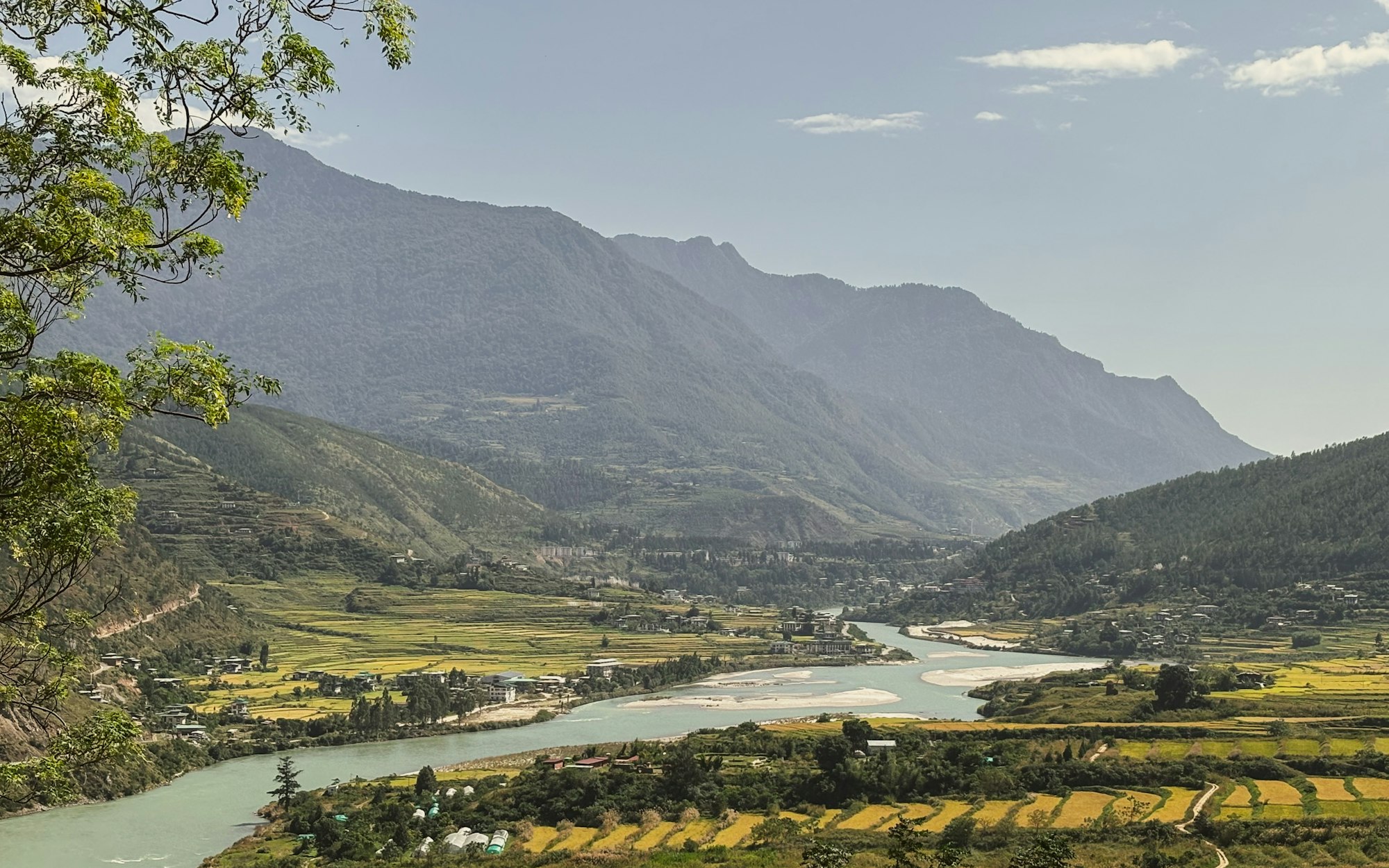
Drop down from the cold Dochula pass and you arrive in a different Bhutan. The Punakha valley lies at around 1,250 metres, so it is warm for most of the year, green with rice terraces and orange trees, and threaded by two clear rivers. At their meeting point stands Punakha Dzong, perhaps the most beautiful building in the country.
Getting there: over the Dochula pass
The road from Thimphu climbs to the Dochula pass at about 3,100 metres. Here the 108 chortens of the Druk Wangyal stand on a hilltop among the trees, built at the wish of the Queen Mother Ashi Dorji Wangmo Wangchuck. On a clear day, most often between October and February, the eastern Himalaya stretch across the horizon. The Druk Wangyal Lhakhang beside the chortens is worth a visit, and a festival is held at the pass every December.
From the pass the road winds down through forest to Lobesa and the valley floor, a descent of almost 2,000 metres. The whole drive takes around two and a half to three hours without stops.
Punakha Dzong
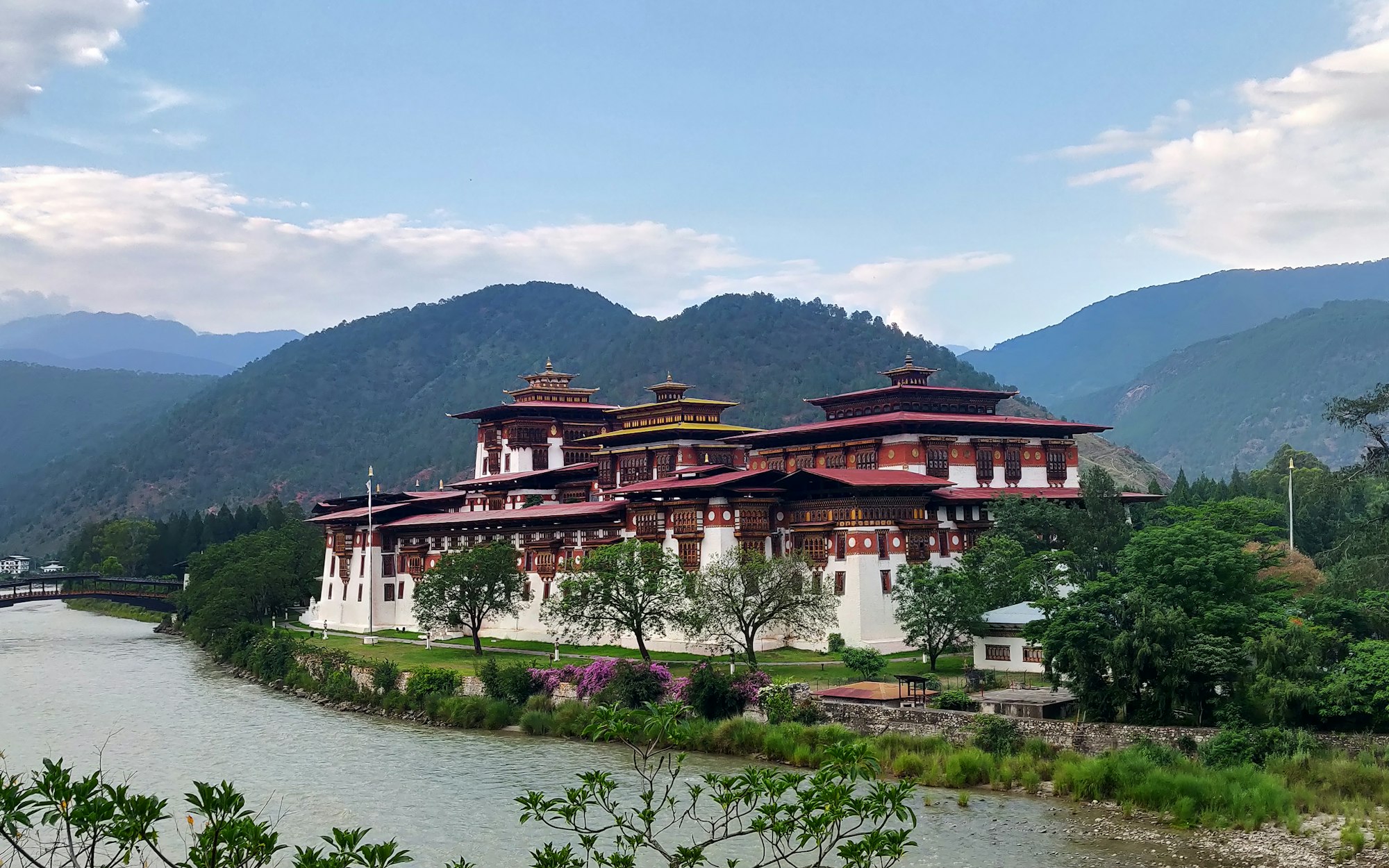
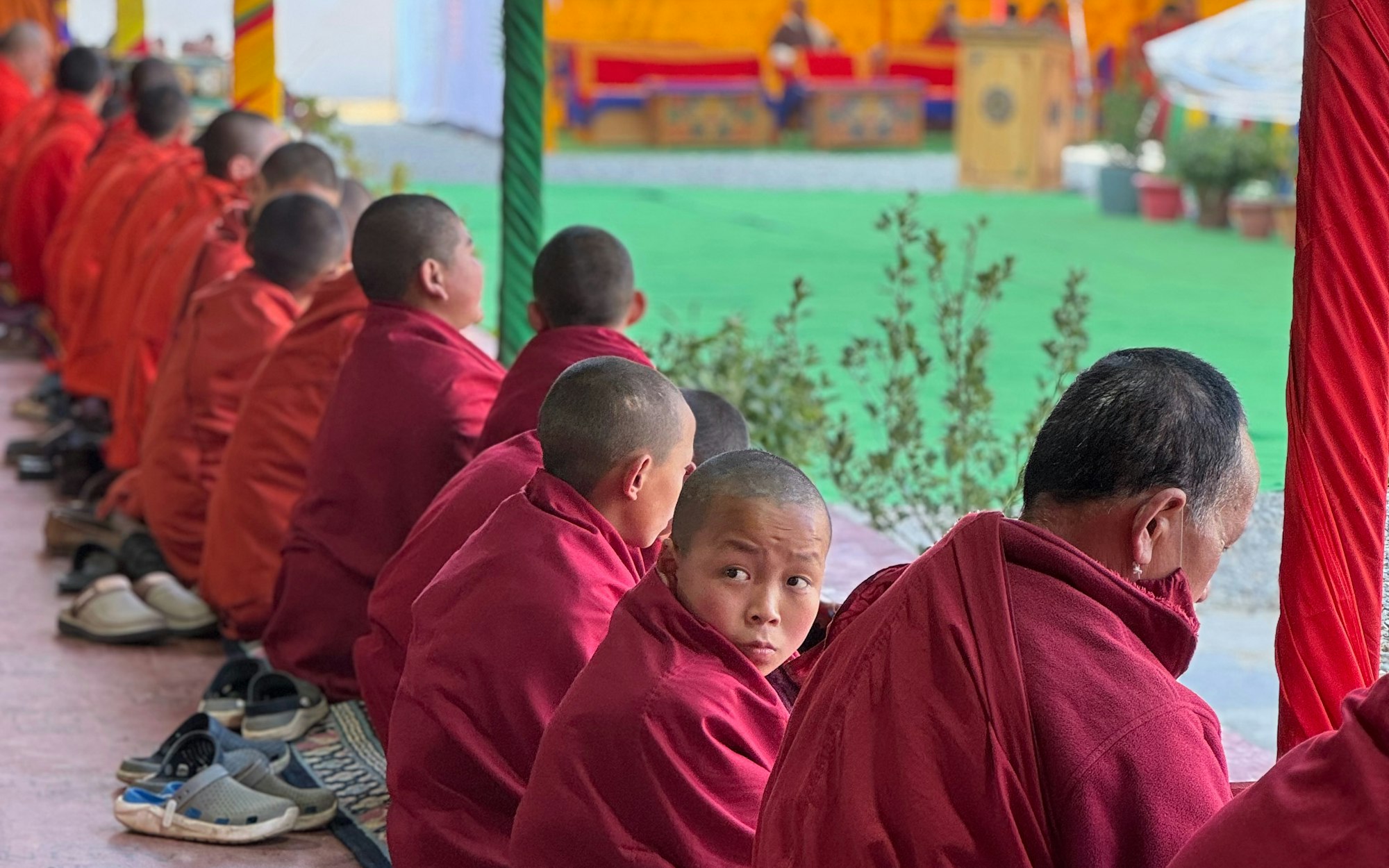
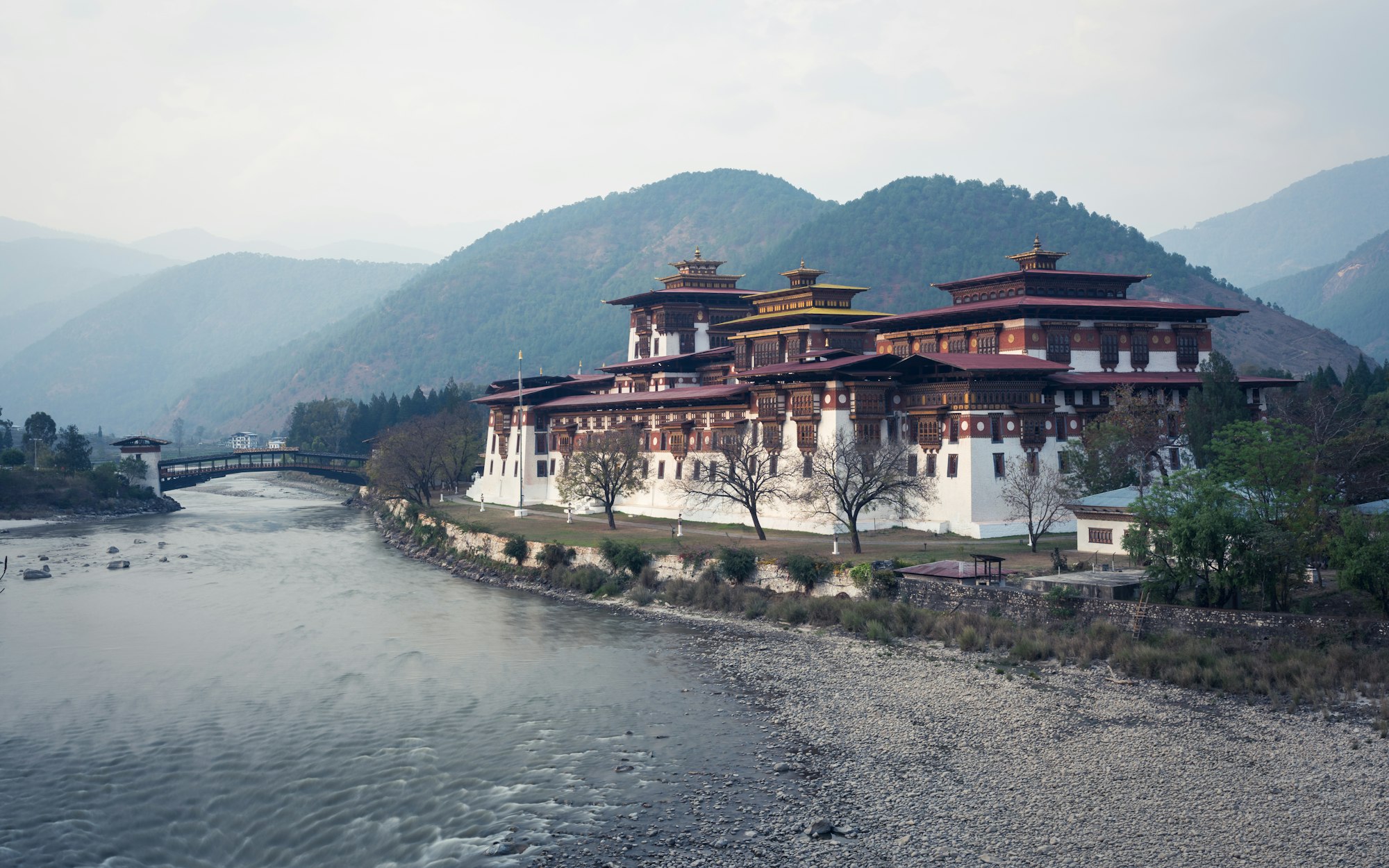
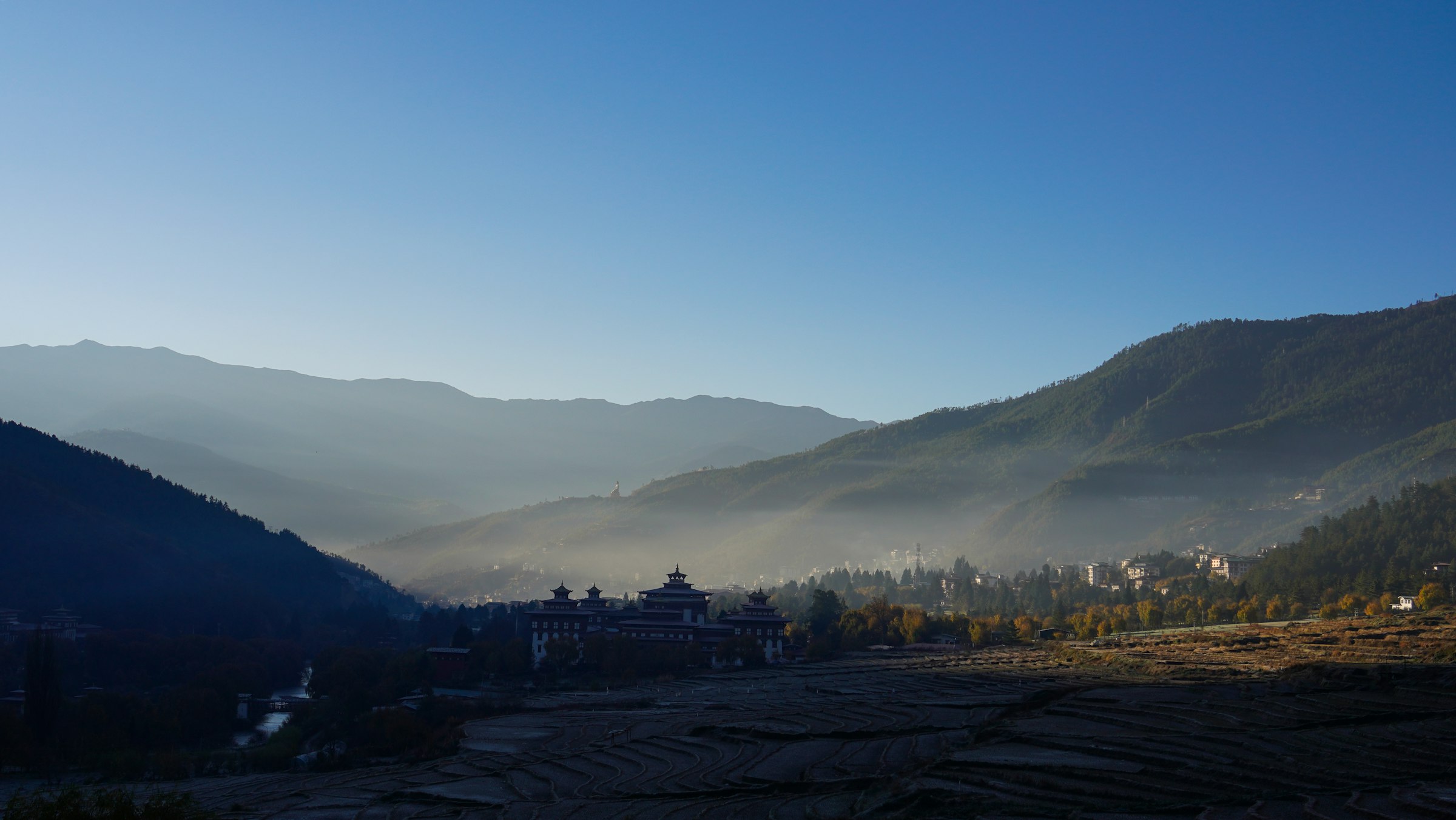
Punakha Dzong was built in 1637–38 by Zhabdrung Ngawang Namgyal at the point where the Pho Chhu and Mo Chhu, the 'father' and 'mother' rivers, meet. It served as the seat of government until the 1950s and remains the winter home of the Je Khenpo, the chief abbot, and the central monastic body, who move here from Thimphu each year.
You enter across a covered wooden cantilever bridge and climb steep steps into a series of courtyards. Inside are some of the most sacred relics in Bhutan and a magnificent assembly hall with gilded statues. In spring, the jacaranda trees around the dzong flower in purple, and the courtyards fill for the Punakha Drubchen and Tshechu, festivals that recall Bhutan's victories in the seventeenth century.
Chimi Lhakhang, the fertility temple
Chimi Lhakhang stands on a small hill in the middle of the valley, reached by a pleasant walk of about twenty minutes through rice fields and the village of Sopsokha. It was built in 1499 in honour of Drukpa Kunley, the 'Divine Madman', a fifteenth-century saint who taught with humour, outrageous behaviour and songs, and who is remembered with great affection in Bhutan.
Couples hoping for children come from all over Bhutan and beyond to receive a blessing here, and many children in the area are named by the temple's lama. In Sopsokha you will notice phalluses painted on the walls of houses and carved in wood: they are symbols of the saint and protection against evil, and Bhutanese people see nothing shocking in them.
Khamsum Yulley Namgyal Chorten
On a ridge at the northern end of the valley, Khamsum Yulley Namgyal Chorten was commissioned by the Queen Mother Ashi Tshering Yangdon Wangchuck and consecrated in 1999. It was built to traditional principles, without plans, and dedicated to the wellbeing of the country and the world.
The walk up from the footbridge across the Mo Chhu takes around 45 minutes to an hour through rice fields and pine. Inside, the paintings are unusually rich, and from the roof you look down the full length of the valley, with the river winding south towards Punakha Dzong. It is one of the finest short walks in western Bhutan.
The Punakha suspension bridge
Just upstream of the dzong, a long suspension bridge hung with prayer flags crosses the Pho Chhu. It is one of the longest in Bhutan, roughly 160 metres, and walking across as it sways gently above the water is a small adventure in itself. Villagers use it every day to reach the farms on the far bank, so please give way to people carrying loads.
Rivers, rafting and walks
The Mo Chhu and Pho Chhu are clear, cold rivers, and from autumn to spring gentle rafting and kayaking trips run down the Mo Chhu to finish below the dzong. It is a calm float rather than whitewater, suitable for most people, and gives an unusual view of the dzong from the water.
The valley is also excellent for easy walks: through the terraces to Chimi Lhakhang, along the river, or up to the villages on the valley sides. In the evening, a farmhouse dinner and a traditional hot-stone bath are a lovely way to end a day here.
Wangdue Phodrang and the road east
Just south of Punakha, Wangdue Phodrang Dzong stands on a spur above the river. Destroyed by fire in 2012, it was rebuilt using traditional methods and reconsecrated in 2022. Wangdue is also the gateway to the Phobjikha valley and to central Bhutan, so Punakha is a natural stop on any journey heading east.
A day in the Punakha valley
- Morning: walk through the rice terraces and Sopsokha village to Chimi Lhakhang, before the day warms up.
- Late morning: Punakha Dzong, while the light is still soft on the river.
- Lunch: a riverside picnic or a meal at a local restaurant.
- Afternoon: the suspension bridge, then the walk up to Khamsum Yulley Namgyal Chorten for the view down the valley.
- Evening: a farmhouse dinner and a traditional hot-stone bath.
The Punakha festivals
Punakha's festival season comes in late winter or early spring, when the monastic body is in residence. The Punakha Drubchen is famous for its re-enactment of a seventeenth-century battle against Tibetan forces, with local men in the dress of the old militia, the pazap, marching and shouting in the dzong courtyard. It is followed by the Punakha Tshechu, with masked dances and the unrolling of a great thongdrel. Dates follow the lunar calendar and change each year.
Villages above the valley
The slopes above Punakha are dotted with farming villages and small temples that few visitors reach. Talo, on a ridge above the western side of the valley, has a monastery with wide views and a festival of its own, and walks between villages give a glimpse of rural life: farmers working the terraces, children walking home from school, and houses with chillies drying on the roofs in autumn. Ask your guide to include one if you have a second day.
Punakha with children
Punakha is one of the most family-friendly places in Bhutan. The walks are short and gentle, the suspension bridge is an adventure, the rafting is calm, and the warm climate makes picnics easy. Families who come in winter, when it is cold in Paro and Thimphu, find the valley especially welcoming.
When to go
Punakha is pleasant all year, but each season is different. Spring, from March to May, brings jacaranda blossom and the valley's festivals. Summer is hot and humid with monsoon rain. Autumn, from late September to November, is clear, with golden rice ready for harvest. Winter is mild in the valley, which is why the monastic body moves here, and the Dochula pass offers its clearest mountain views.
Where to stay and how long
There are farmhouse homestays, comfortable mid-range hotels and some of Bhutan's finest luxury lodges in and around the valley. One full day is enough for the dzong, Chimi Lhakhang and the suspension bridge; two days add Khamsum Yulley Namgyal Chorten, a river trip and a slower pace. Most of our journeys spend one or two nights here.
Frequently asked questions
How far is Punakha from Thimphu?
Punakha is around 70 kilometres from Thimphu, a drive of about two and a half to three hours over the Dochula pass.
What is Punakha Dzong famous for?
Punakha Dzong, built in 1637–38 where two rivers meet, is considered the most beautiful dzong in Bhutan. It was the seat of government until the 1950s and is the winter home of the central monastic body.
Why is Chimi Lhakhang called the fertility temple?
Chimi Lhakhang honours Drukpa Kunley, the 'Divine Madman'. Couples hoping for children visit to receive a fertility blessing from the temple.
Is Punakha worth visiting in summer?
Yes, though it is hot and humid with monsoon rain from June to August. Spring and autumn are the most comfortable seasons.

Written by
The Bhutan Travel Nexus team, Bhutan-based travel designers who plan private journeys across the kingdom. Facts were checked in ; fees and rules can change, so we confirm them when you book.